
Every year, Uganda's economic managers announce good news. Growth is up. Foreign direct investment (FDI) hit a record. Uganda is "one of the fastest-growing economies in Africa." In 2024, GDP grew by roughly 6.3% and FDI inflows reportedly touched an all-time high of about $3.3–3.4 billion, according to Bank of Uganda (BoU) data — a striking outcome given that global FDI actually fell by 11% that year as the rest of the world turned cautious.
That is the headline. The subplot, buried deeper in the same BoU reports, tells a more complicated story: while foreign-owned companies operating in Uganda posted higher profits in 2024, they also sent record amounts of money back home. Dividend declarations by foreign firms rose 32.5%, but dividends actually remitted abroad jumped 62.1% — nearly double the rate of profit growth itself. Retained earnings - the portion of profit foreign firms chose to reinvest in Uganda rather than send home actually fell by 7.7% to about $493 million. In plain terms: as foreign companies made more money in Uganda, they kept a shrinking share of it here.
This is the tension worth sitting with. Uganda is not short of investors. It is arguably short of investment that stays.
The shape of Uganda's investor map
Broadly, five blocs dominate the foreign capital story in Uganda today, each with a different footprint, history and relationship to the local economy.
1. The banks: South African and European ownership of the financial sector
Uganda's banking system is, in an important sense, not Ugandan-owned. The sector traces its modern shape to the early 2000s privatization wave, when the state-owned Uganda Commercial Bank — once the country's dominant retail bank with a nationwide branch network — was sold to South Africa's Standard Bank Group in 2002 and merged into what is now Stanbic Bank Uganda. Today, Stanbic remains the country's largest bank by assets, roughly 80% owned by its South African parent through Stanbic Africa Holdings, with the remainder held by Ugandan institutions and individuals on the Uganda Securities Exchange.
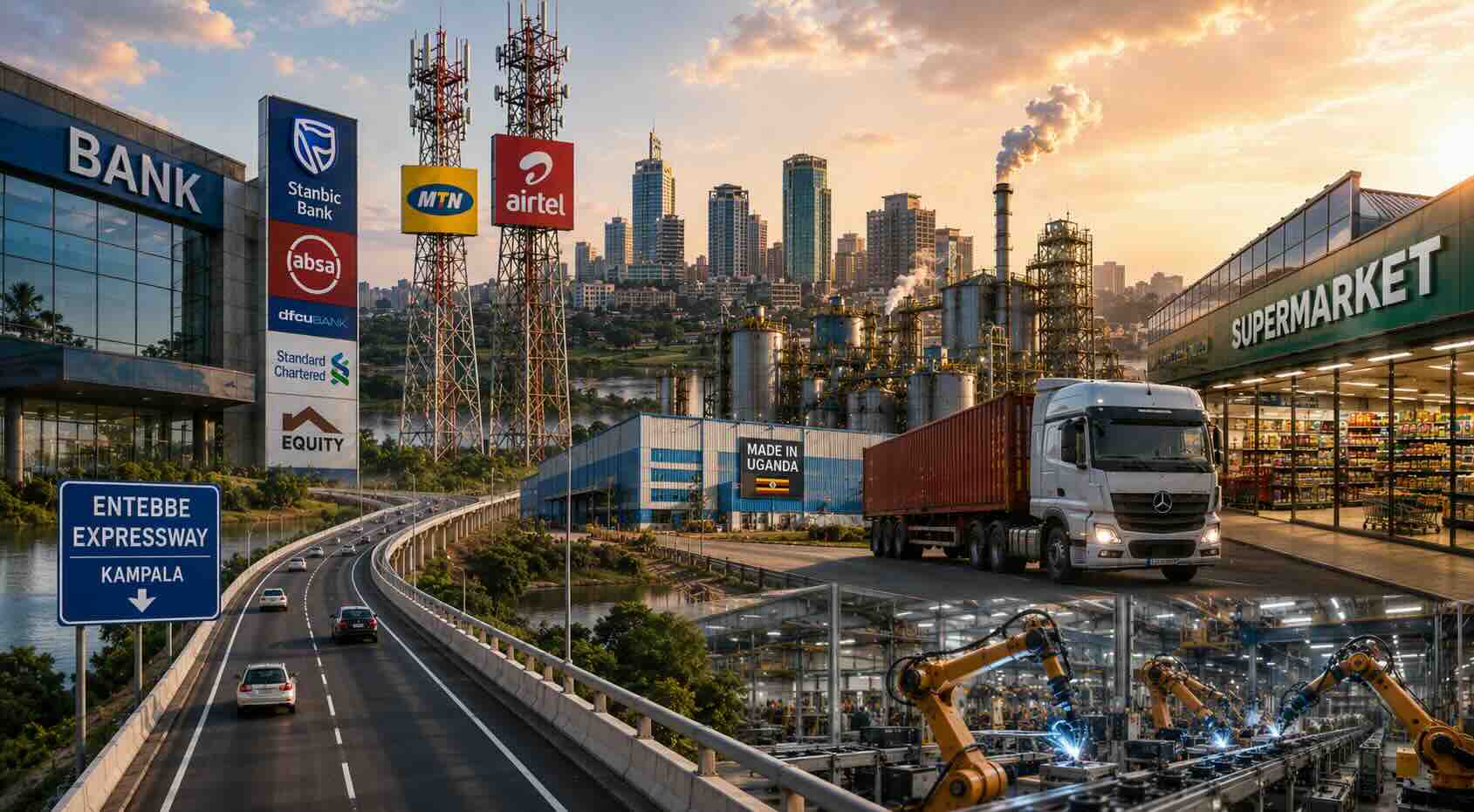
Stanbic isn't an outlier; it's representative. Uganda has 22–26 licensed commercial banks and the top five hold well over half of all banking assets. Among the systemically important banks - Stanbic, Standard Chartered, Centenary, Absa, Dfcu and Equity; most are either majority foreign-owned (South African, British, Kenyan) or structured so profits flow to a parent holding company domiciled abroad. Standard Chartered's roots are British/Asian colonial-era banking. Absa is South African. Equity Bank is Kenyan. Even Centenary Bank, often cited as more "local," has foreign development-finance shareholders in its capital structure.
Why does ownership matter here? Because banks aren't like a factory that simply produces goods for local consumption - they are the plumbing of the entire economy. When the institutions that decide who gets credit, at what price and for what purpose are headquartered in Johannesburg, London, or Nairobi, their boards answer first to shareholders there.
Profits and increasingly the decision of how much profit to retain locally versus repatriate as dividends; are made outside Uganda. Analysts have long flagged that Uganda's banking sector, with most banks domiciled or parented overseas, is structurally exposed to capital flight during global shocks: when a South African or British parent needs capital at home, it can pull it from African subsidiaries.
2. The Indian business community: an old, embedded and re-exporting elite
The Indian presence in Uganda's economy is the oldest and most structurally significant of the foreign blocs - older than independence itself, dating to railway-era migration in the late 19th century. It was violently interrupted in 1972, when Idi Amin expropriated Asian-owned businesses and expelled the community; many of those properties were only returned to original owners or descendants decades later.
Since the 1990s, the community has rebuilt and expanded its footprint dramatically. Today there are an estimated 35,000 Indians and persons of Indian origin (PIOs) living in Uganda concentrated in Kampala and Jinja — who make up less than 0.1% of Uganda's population but who, by some estimates cited by India's own High Commission in Kampala, contribute a hugely disproportionate share of the country's direct tax revenue (figures as high as 65% of corporate tax revenue have been cited at bilateral investment forums, though such figures should be read as illustrative of concentration rather than precise accounting). Indian and PIO investors are estimated to have put over $1 billion into Uganda over the last two decades, dominant in manufacturing, sugar, agro-processing, banking, real estate, hotels and increasingly IT.
This is the community most often invoked in everyday Ugandan conversation about foreign ownership - the "dukawallah" stereotype has given way to industrial conglomerates: sugar estates, edible oils, steel, plastics, cement and retail chains, many controlled by a small number of prominent Indian-Ugandan business families. The pattern you describe — "many that are always going back to their Indian" - reflects a real and long-documented phenomenon: profits and often even mid-level staff and procurement, circulate within transnational Indian business networks (India, Uganda, UK, UAE, Kenya) rather than being ploughed back exclusively into the Ugandan economy. At the same time, unlike newer investor blocs, much of Indian capital in Uganda is invested in fixed productive assets - factories, plantations, milling which is harder to relocate than portfolio capital and does generate substantial direct local employment.
3. European and American capital: oil and not much else
Western investment in Uganda today is overwhelmingly a story about one thing: oil. Nearly 78.5% of all FDI inflows recorded in 2024 were linked to petroleum activity and the single largest Western investor is France's TotalEnergies, which holds 62% of the East African Crude Oil Pipeline (EACOP) and operates the Tilenga oil development. The Netherlands, the UK and Mauritius (often a routing jurisdiction for other countries' capital) round out the top sources of FDI.
This concentration is worth pausing on. It means Uganda's celebrated FDI "boom" is not diversified industrial investment creating broad-based employment; it is capital-intensive extraction and pipeline construction, sectors that generate large investment figures and some construction-phase jobs, but comparatively few permanent jobs relative to capital deployed and whose profits will overwhelmingly be repatriated once oil begins flowing (expected around late 2026). Manufacturing; the sector most likely to create durable, broadly shared jobs accounted for only about 8.3% of 2024 FDI inflows.
American investment, by contrast, remains modest; the US State Department's own investment climate assessment for Uganda flags corruption, an aggressive tax authority and political uncertainty ahead of the 2026 elections as active deterrents, alongside genuine opportunities in the growing oil and gas sector.
4. Gulf and Middle Eastern capital: courtship without volume — yet
The UAE relationship has intensified fast. The 4th Uganda-UAE Business Forum in late 2025 saw Ugandan officials pitch the country's "ATM" pillars; agriculture, tourism, minerals, manufacturing directly to Emirati investors, with government framing Uganda as offering "one of the highest returns on investment on the continent." Gulf capital so far skews toward real estate, hospitality and increasingly gold and mineral trade (Uganda has become a significant transit point for regional gold exports, much of it destined for UAE refineries a trade that has drawn scrutiny for its opacity and links to conflict minerals from the wider Great Lakes region). This bloc is smaller in absolute FDI terms than the others discussed here, but it is growing quickly and deserves the same scrutiny once volumes rise, particularly around gold trade transparency and profit accounting.
5. The Chinese wave: infrastructure debt, industrial capacity and now retail shelves
China's role in Uganda has evolved through three distinct phases and understanding all three is essential to understanding why Chinese investment provokes such different reactions from different Ugandans.
Phase one: the roads and dams. Since the mid-2000s, China has become Uganda's dominant infrastructure financier and, by some measures, its top source of FDI since 2009. Uganda is the second-largest recipient of Chinese loans in the East African Community, absorbing roughly 34% of the $7.3 billion in Chinese lending to the region between 2015 and 2022. Landmark projects the $350 million Kampala–Entebbe Expressway, the $1.7 billion 600MW Karuma Hydropower Dam, the Isimba dam - were financed by Chinese Exim Bank loans and, crucially, built by Chinese contractors, meaning much of the construction spending never touched the local construction industry. Analysts have noted this pattern deprives Ugandan firms of the chance to build capacity for large infrastructure work, even as it addresses genuine deficits in power and transport. Whether this constitutes a "debt trap" is contested: some argue China's loans are tied to revenue-generating assets (toll roads, power sales) that are structurally designed to be serviced and Uganda's debt-to-GDP ratio (over 52% as of December 2024) remains within commonly cited sustainability thresholds, if rising. Others point to the lack of transparency in loan terms and the near-total absence of Ugandan contractors from the delivery chain as the real cost, separate from repayment risk.
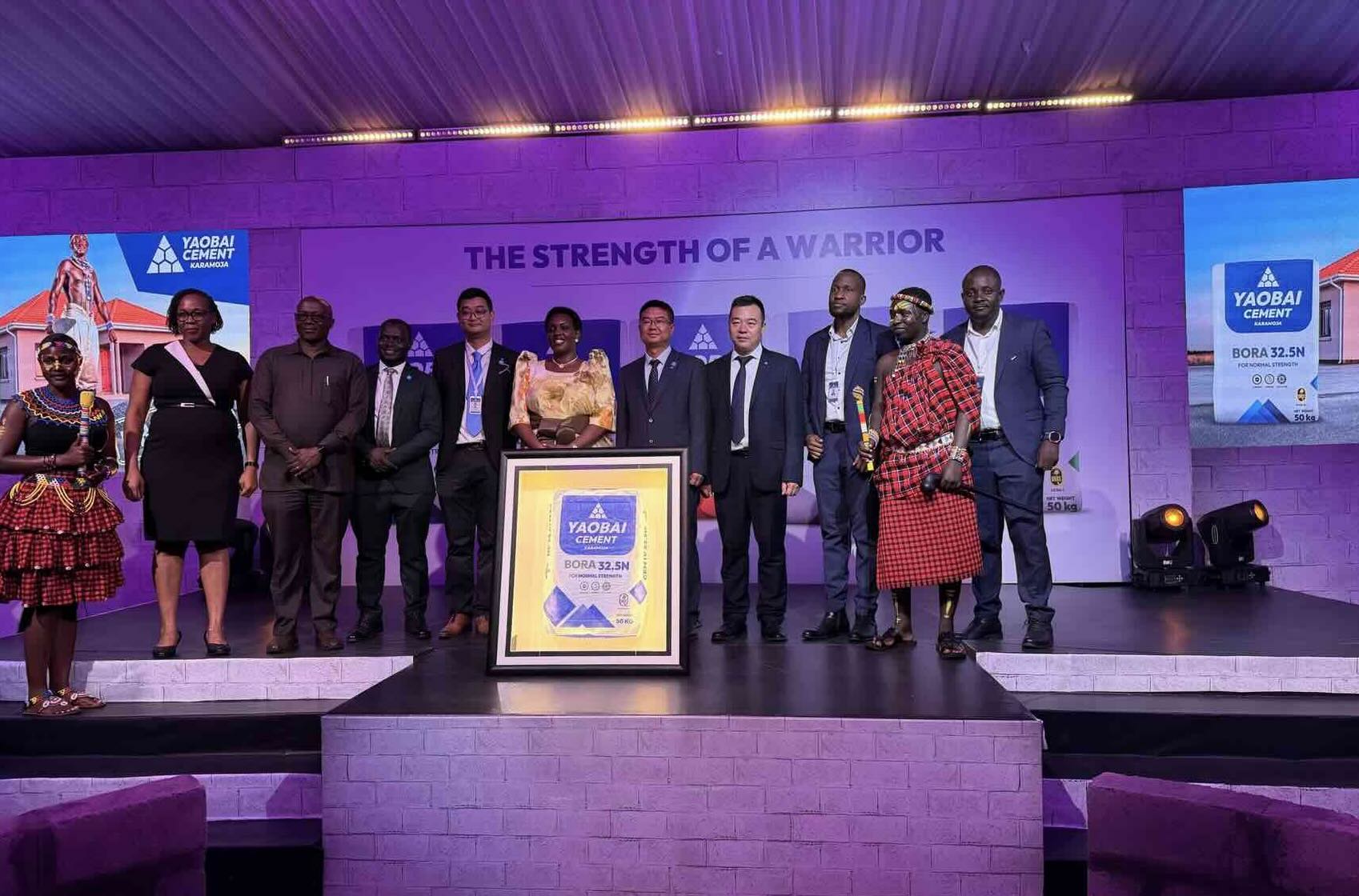
Phase two: industrial capacity - including a stake in oil itself. China is not only a lender; CNOOC (China National Offshore Oil Corporation) holds 8% direct equity in EACOP and operates the Kingfisher oil field, making China one of only four shareholders in Uganda's flagship oil infrastructure alongside TotalEnergies (62%), Uganda's own UNOC (15%) and Tanzania's TPDC (15%). On the industrial side, Chinese firms have moved into cement in a serious way: West China Cement is investing roughly $250 million in a new Ugandan plant (about 70% debt-financed), following an earlier Chinese-backed cement investment in Karamoja and a further plant under construction in Buikwe. Chinese-owned firms are also active in steel, garment assembly and vehicle/motorcycle assembly under Uganda's industrial park program.
Phase three: retail - the one Ugandans feel most directly. This is where the "China Mart" and "China Town" phenomenon your readers will recognize comes in. When China Town Super Store opened in Kampala's Lugogo Mall in August 2024 — a 6,000 square-metre store in the space vacated by South Africa's Shoprite (itself an earlier foreign retail exit) it drew crowds of roughly 5,000 shoppers a day and was briefly shut by police due to overcrowding. Its prices, some reportedly 50% below local retailers, delighted consumers exhausted by markups from Kampala's traditional trading hubs like Kikuubo — but triggered immediate alarm from the Kampala City Traders Association (KACITA), whose chairperson Thaddeus Musoke Naggenda argued that foreign retail investment "not only outcompete[s] local operators but also sideline[s] Ugandan suppliers." A government policy requiring 40% of shelf space in such stores to be reserved for Ugandan-made goods exists, but by most on-the-ground accounts, imported Chinese goods dominate the actual inventory. More outlets under similar branding have since followed and the trend now extends beyond Kampala.
The economic logic here is genuinely double-edged in a way the other investor categories are not. China Town and similar stores generate real consumer surplus (cheaper goods for ordinary Ugandans), some direct employment and import-tax revenue. But they also compress the margins and threaten the survival of Uganda's vast informal and small-trader retail economy, which employs far more people per shilling of turnover than a hypermarket does and they do essentially nothing to build Ugandan manufacturing capacity, since most goods arrive finished from Chinese factories rather than being made or even assembled locally. Researchers have also flagged early evidence of Chinese capital moving into agricultural production - including rice raising longer-term questions about whether the same retail-disruption pattern could eventually reach staple food production and smallholder farming.
The unifying problem: profit repatriation and the "growth" illusion
Step back from the individual blocs and a single mechanism connects all of them: Uganda's legal framework makes it easy and lawful for foreign capital to leave. The 2019 Investment Code Act explicitly guarantees investors the right to repatriate profits, dividends and capital and investors can transfer foreign exchange out through commercial banks without Bank of Uganda approval. This is standard practice for attracting FDI globally and Uganda's government treats it as a competitive necessity but it means that GDP growth and FDI inflow figures, taken alone, systematically overstate the domestic benefit of foreign investment.
Consider what the numbers actually show for 2024:
FDI inflows: roughly $3.12–3.4 billion (accounts vary by methodology), a record high.
Dividends remitted abroad: up 62.1% year-on-year - nearly double the growth in the profits that generated them.
Retained earnings (profit reinvested in Uganda): down 7.7% to about $493 million.
Sectoral concentration: ~78.5% of FDI tied to oil and gas, ~22% specifically to EACOP-related transport construction, only ~8.3% to manufacturing.
Put differently: Uganda is attracting record capital, but an increasing share of the return on that capital leaves the country and the capital that does arrive is heavily concentrated in one capital-intensive extractive sector rather than being spread across job-rich manufacturing or agro-processing. Economists at Uganda's own Economic Policy Research Centre and elsewhere have warned publicly that this repatriation trend "could hinder capital accumulation in the country" - the very thing FDI is supposed to help build.
This matters for how ordinary Ugandans should read headline growth numbers. GDP growth captures the value producedwithin Uganda's borders in a given year including profits that will shortly leave. It says nothing about whose balance sheet that value ultimately sits on a year later. A more honest national accounting would track Gross National Income (GNI), which nets out income repatriated to foreign owners, alongside GDP — and even then, GNI understates the deeper issue of who controls decision-making over reinvestment, credit allocation and industrial strategy.
What's actually at stake
None of this is an argument against foreign investment as such. Uganda genuinely needs external capital: its own savings and tax base are too thin to finance the roads, power plants and oil infrastructure the country wants and foreign firms bring technology, market access and employment that would not otherwise exist. The Investment Code's repatriation guarantees exist precisely because, without them, much of this capital would go to competing markets in Kenya, Rwanda, or elsewhere instead.
But there is a real difference between investment blocs by how much of their return stays and recirculates in Uganda:
Roots that go deep, even if profits leave partially: Indian manufacturing and agro-processing capital, because it is embedded in fixed local assets, plantations and multi-generational business families, tends to reinvest and employ more durably even as it also exports significant profit through transnational family networks.
Roots that are structurally shallow: banking sector ownership concentrated in a handful of foreign parent groups, where dividend policy is set at a Johannesburg or London board table and can be adjusted from one year to the next based on conditions having nothing to do with Uganda.
Extraction with a repatriation clock already ticking: European and Chinese oil capital, which by its nature generates a defined, finite revenue stream that both TotalEnergies and CNOOC will substantially repatriate once production begins, tempered only by the size of Uganda's own equity stake through UNOC (15% of EACOP, up to 40% of the planned refinery).
Debt-financed public assets with limited local industrial spillover: Chinese infrastructure lending, which builds real, needed assets (roads, dams) but through a model that has historically excluded Ugandan contractors from the value chain, meaning the multiplier effect on local skills and firms is smaller than the headline project value suggests.
Consumer-facing disruption with minimal reinvestment: Chinese retail expansion (China Town, China Mart and similar), which delivers immediate price relief to consumers but threatens the livelihoods of a much larger, labour-intensive informal trading sector, while contributing comparatively little to local production capacity or reinvested profit.
The honest conclusion is not that Uganda should reject foreign capital, but that the composition of that capital - not just its volume should be the object of policy attention and public scrutiny. A $3.4 billion FDI headline that is 78% oil-related and increasingly repatriated in dividends is a very different economic story than the same headline figure spread across manufacturing, agro-processing and technology with high local reinvestment rates. Uganda's policymakers and its citizens weighing "growth" statistics at election time, would do well to ask not just how much is coming in, but how much is staying and in whose hands the decision about that gets made.
Sources for figures cited: Bank of Uganda / UBOS / Uganda Investment Authority Private Sector Investment Survey 2025; US Department of State 2025 Investment Climate Statement for Uganda; EACOP Ltd shareholder disclosures; Economic Policy Research Centre (EPRC) Uganda; India High Commission Kampala; Devpolicy Blog (ANU).