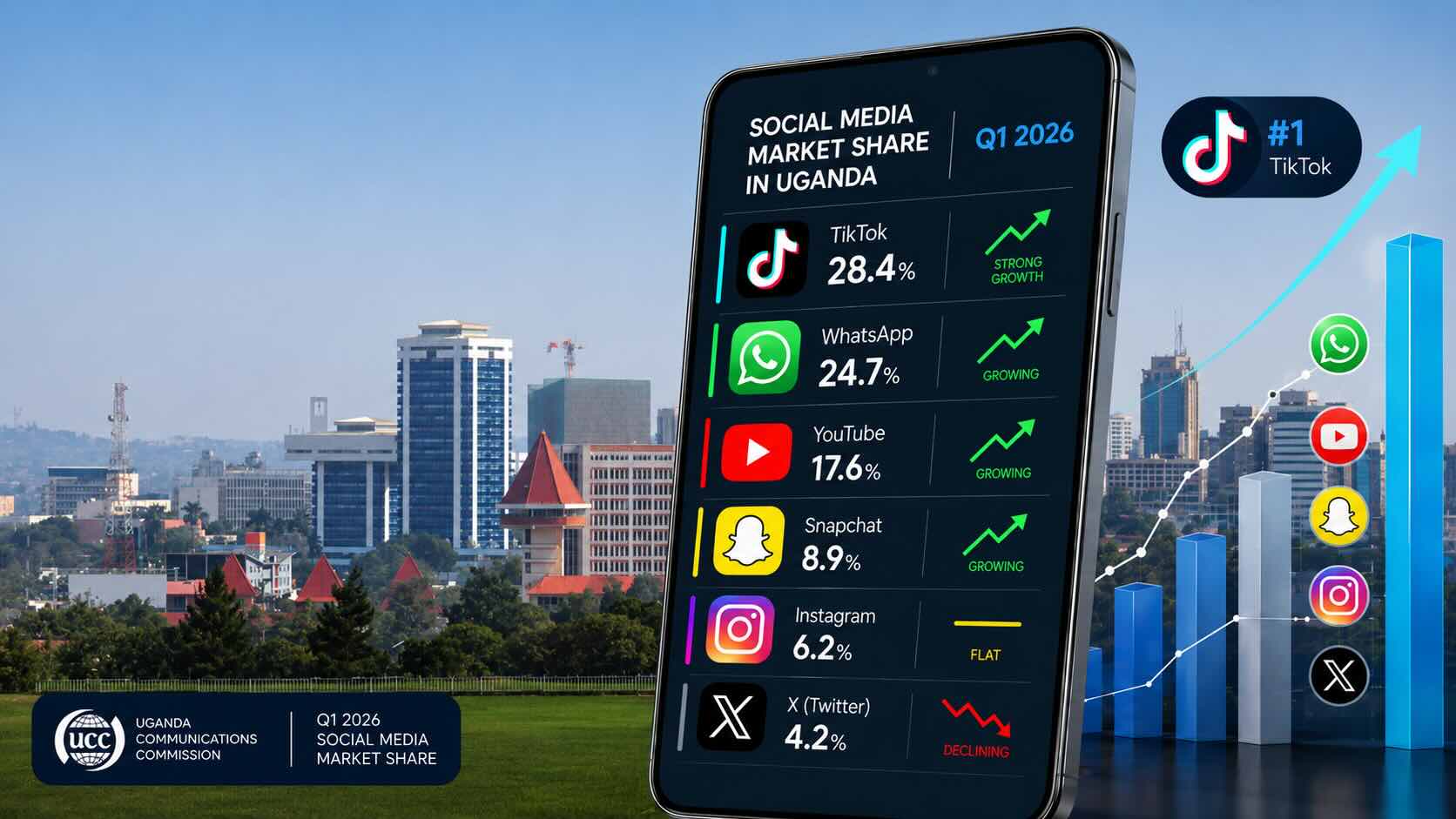
Uganda’s social media landscape is undergoing a major shift, with TikTok overtaking WhatsApp as the country’s most subscribed social media platform, according to the latest market data from the Uganda Communications Commission (UCC).
For years, WhatsApp has been the dominant digital platform in Uganda, serving as the everyday communication tool for families, businesses, schools, community groups and informal traders. But the latest UCC figures show that TikTok has now moved ahead, with 10.8 million subscriptions compared to WhatsApp’s 9.9 million by March 2026.
The change marks a turning point in Uganda’s digital economy. It signals that social media is no longer being driven mainly by messaging and direct communication, but increasingly by short-form video, entertainment, digital influence, online marketing and creator-led business activity.
Together, TikTok and WhatsApp account for 20.7 million subscriptions, underlining their dominance in Uganda’s online ecosystem. However, the movement between the two platforms suggests that user behaviour is changing quickly, especially among young, mobile-first internet users.
TikTok’s rise reflects Uganda’s video-first internet culture
According to UCC market reports covering the period between June 2025 and March 2026, WhatsApp remained Uganda’s leading social media platform throughout most of 2025. It had 9.2 million subscriptions in June 2025, rose to 10 million in September and peaked at 11.4 million in December.
However, by March 2026, WhatsApp subscriptions had dropped to 9.9 million.
TikTok, meanwhile, followed a strong growth path. The platform grew from 8.8 million subscriptions in June 2025 to 9.3 million in September, before rising sharply to 11.3 million in December. Although TikTok also eased slightly to 10.8 million by March 2026, its decline was smaller than WhatsApp’s, allowing it to take the top position.
The numbers point to a wider transformation in how Ugandans use the internet. While WhatsApp remains essential for messaging, calls, file sharing, school groups, business communication and customer support, TikTok has become the platform where many users spend time consuming content, discovering trends, following creators and engaging with brands.
Short-form video has become one of the most powerful formats in the digital world because it is fast, visual and easy to consume. In Uganda, where smartphone adoption continues to grow, TikTok’s format is proving especially attractive to young people who prefer quick, entertaining and highly shareable content.
A new opportunity for creators, brands and businesses
TikTok’s growth is not only a social media story. It is also a business story.
The platform has become a key tool for small businesses, artists, influencers, entertainers, media personalities and entrepreneurs who want to reach audiences without relying only on traditional advertising. A single short video can introduce a product, promote a service, build a personal brand or attract customers at a relatively low cost.
For businesses, TikTok is increasingly becoming the top-of-funnel platform: the place where attention is created. A restaurant, fashion store, salon, real estate agent or retail business can use TikTok to generate awareness, show products, explain offers and spark interest. WhatsApp then often becomes the next step, where inquiries, negotiations, bookings and transactions take place.
This means TikTok and WhatsApp are not simply replacing each other. In many cases, they are becoming complementary tools in Uganda’s digital commerce chain. TikTok attracts the customer; WhatsApp helps close the sale.
This shift has important implications for marketing teams. Businesses that still treat social media mainly as a place to post static graphics may need to rethink their strategies. Audiences are increasingly responding to authentic, short, mobile-friendly video content that feels natural rather than overly corporate.
For brands, the message is clear: attention is moving toward video-first platforms and marketing budgets may need to follow.
YouTube and Snapchat show strong demand for visual content
The UCC data also shows that other visual platforms are performing strongly.
YouTube maintained steady growth over the review period. Subscriptions increased from 6.1 million in June 2025 to 6.3 million in September and 7.2 million in December, before moderating to 6.5 million by March 2026.
The platform remains Uganda’s leading long-form video service, supported by demand for music videos, education, tutorials, live streaming, religious content, entertainment and digital advertising.
Snapchat also recorded one of the fastest growth rates among major platforms. Subscriptions increased from 2.2 million in June 2025 to 2.5 million in September and 3.2 million in December, before easing to 2.8 million in March 2026.
Although Snapchat’s overall numbers remain far below TikTok and WhatsApp, its growth suggests that younger users are increasingly experimenting with more visual and private forms of digital interaction.
Instagram stagnates as X loses mass-market appeal
While TikTok, YouTube and Snapchat continue to benefit from the rise of visual content, Instagram appears to have reached a plateau in Uganda.
The platform recorded 1.5 million subscriptions in June 2025, dropped to 1.3 million in September, recovered to 1.5 million in December and slipped again to 1.4 million by March 2026.
Instagram remains relevant among influencers, celebrities, fashion brands, lifestyle businesses and some urban audiences. However, its growth has largely stagnated at a time when TikTok and Snapchat are attracting younger users more aggressively.
X, formerly Twitter, recorded the steepest decline among the major social platforms tracked. Subscriptions fell from 1.1 million in June 2025 to 700,000 by September and remained at that level through December 2025 and March 2026.
Despite the decline, X continues to play an important role in public debate, politics, journalism, corporate communication and real-time news conversations. However, its appeal appears more concentrated among professionals, policymakers, media users and older audiences, rather than the wider mass market.
This does not necessarily mean X has become irrelevant. Instead, it suggests that the platform now serves a narrower audience and a more specific purpose compared to TikTok, WhatsApp, Facebook-style communities and other visual networks.
Netflix remains niche in Uganda
The UCC figures also show that Netflix remains a niche digital platform in Uganda. Subscriptions declined from 200,000 in June 2025 to 100,000 by September and remained at that level through March 2026.
The slow adoption of Netflix reflects the challenges facing paid streaming platforms in a market where affordability remains a major issue. Many Ugandan consumers still rely on free or low-cost entertainment options, while streaming video through mobile data can be expensive.
Netflix adoption is likely concentrated among urban households with smart TVs, reliable fixed internet connections and higher disposable income. Wider growth may depend on cheaper broadband, more unlimited internet packages and stronger home connectivity.
Smartphone growth is reshaping digital behaviour
The rise of TikTok also comes at a time when Uganda’s smartphone base is expanding. UCC data shows smartphone ownership increased from 17.6 million devices in June 2025 to 20.3 million by March 2026.
As more Ugandans gain access to smartphones capable of streaming video, platforms built around visual content are likely to keep growing. This creates major opportunities for telecom operators, advertisers, media companies, creators and digital entrepreneurs.
Telecom companies are already responding through social media bundles and app-specific data packages that make access to platforms such as TikTok, WhatsApp, YouTube and Snapchat more affordable for users.
For advertisers, the message is equally important. Uganda’s digital audience is not only growing; it is changing. The most effective online campaigns may increasingly be those built around mobile video, creator partnerships, influencer marketing and direct customer engagement.
What this means for Uganda’s digital economy
TikTok becoming Uganda’s most subscribed social media platform is more than a ranking change. It reflects a deeper shift in how people communicate, consume information and participate in the digital economy.
Ugandans are moving from simple online communication toward richer digital interaction. They want platforms that entertain, inform, connect and create economic opportunity at the same time.
For government agencies and public institutions, the trend is also important. Communication strategies may need to adapt to where citizens are spending their time, especially younger audiences who are more likely to consume short video than long official statements.
For businesses, creators and marketers, the opportunity is clear. Uganda’s next phase of digital growth will be shaped by attention, content, community and conversion. TikTok may now lead in subscriptions, but WhatsApp remains deeply important in everyday communication and business transactions.
The future of Uganda’s social media market is therefore not about one platform replacing another completely. It is about different platforms playing different roles in a more mature digital ecosystem.
TikTok has taken the lead, WhatsApp remains powerful, YouTube and Snapchat are growing, Instagram is slowing, X is becoming more specialised and Netflix is still searching for scale.
Uganda’s online audience is evolving fast - and for businesses, policymakers and content creators, the platforms that win attention today may shape the digital economy of tomorrow.