
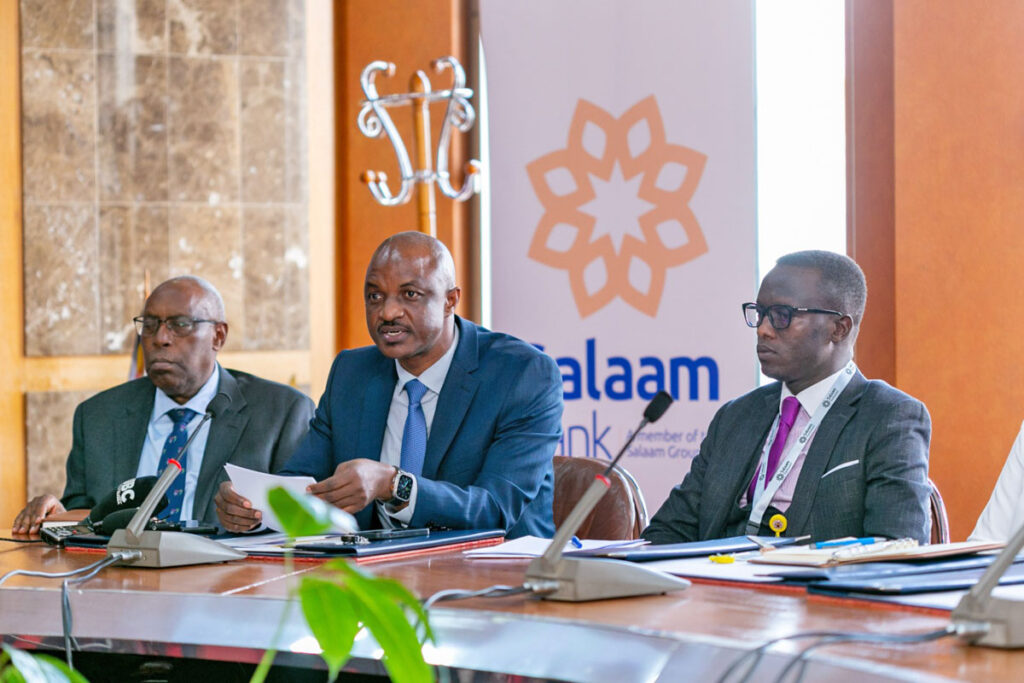

For more than two decades, the idea of an Islamic bank operating in Uganda sat on the shelf — discussed in policy circles, requested by the Muslim community and repeatedly delayed by regulatory gaps. That changed in 2023 and 2024, when Salaam Bank Uganda Limited became the country's first fully licensed Islamic financial institution, formally launched by President Yoweri Museveni in Kampala. Nearly two years on, it's worth asking what the bank has actually brought to a market long dominated by conventional, interest-based lenders — and whether its Shariah-compliant model genuinely offers Ugandans something better.
A long-delayed entry
Uganda first amended its Financial Institutions Act in 2016 to make room for Islamic banking "windows" within existing banks, but a full-fledged Islamic bank required more: a change in the law removing the requirement for a central Shariah advisory council, which the Bank of Uganda had resisted. That hurdle was cleared when Museveni assented to the amended Financial Institutions Act in 2023, clearing the way for Bank of Uganda to license Salaam Bank — a subsidiary of the Djibouti-based Salaam Group, which also operates in Kenya and Somalia and had already acquired Uganda's Top Finance Bank in 2023 as its entry vehicle. The bank formally opened its doors in Kampala and was officially launched by the President in March 2024.
That timing matters. Uganda's Muslim population, along with a wider group of Ugandans uneasy about conventional interest-based finance, had effectively been locked out of a banking model available to their counterparts in Kenya and Tanzania for years. Salaam Bank's arrival was framed by officials, including Secretary to the Treasury Ramathan Ggoobi, as an inclusion story as much as a religious one — he has publicly urged Ugandans of all faiths to make use of Islamic banking, not just Muslims.
What "interest-free" actually means
Salaam Bank's core pitch is that it does not charge or pay interest (riba), which Islamic finance treats as inherently unjust because it guarantees a lender's return regardless of whether the borrower's underlying venture succeeds or fails. Instead, the bank earns income through structures tied to real assets and shared risk — for example, buying an asset a customer needs and reselling it to them at an agreed mark-up payable in installments (a structure known as Murabaha), or entering leasing and partnership-style arrangements rather than straightforward cash loans. In principle, this links the bank's profit to actual economic activity rather than the mere passage of time on a loan balance.
The product line-up
According to the bank's own materials, Salaam Bank has built out a fairly comprehensive retail and business suite for a two-year-old institution, including:
A children's savings account aimed at teaching kids to save with parental involvement
A general Salaam Savings Account for ring-fencing money away from daily spending
A student account designed around young savers building banking habits
A current-style account for day-to-day transactions alongside longer-term goals
A diaspora banking product for Ugandans abroad to stay financially connected home
A business account for company cash management
A dedicated Hajj and Umrah savings product to help customers plan for pilgrimage
A group/community savings account, useful for savings circles and cooperative-style groups
On the current website the account range has grown further, now spanning a Junior Account, Savings Account, Students Account, Prime Account, Business Account and a higher-end Prestige Account for customers who want a more premium banking relationship.
On the financing side, the bank has broadened well beyond simple personal and home finance into sector-specific facilities: agriculture financing, real estate financing, motor financing, business financing, oil & gas financing and even school development financing aimed at institutions investing in education infrastructure. All are structured through Shariah-compliant contracts rather than conventional interest-bearing loans. This sector spread is unusual for a two-year-old bank and signals an ambition to serve niches — smallholder farmers, transport operators, schools — that conventional lenders often treat as an afterthought. The bank's green and real estate financing work, aligned with the UN Sustainable Development Goals, earned it recognition at a 2025 industry awards event, on top of being named Best New Islamic Bank at the 2024 Islamic Finance News Global Awards. More recently, the Salaam Group extended its Uganda footprint into insurance, launching Tamini General Insurance with Museveni in 2026 as the country's first Takaful (Islamic insurance) provider — giving customers a Shariah-compliant option for risk protection alongside banking.
Cards, mobile banking and everyday convenience
Beyond accounts and financing, Salaam Bank has invested visibly in the "convenience" layer of banking that Ugandan customers now expect as standard:
Salaam Visa Prepaid Card — arguably the bank's most distinctive retail product. It is a Shariah-compliant, reloadable card that works for POS payments, online shopping and ATM withdrawals both locally and internationally — and, notably, it does not require the holder to first open a full bank account. That makes it a genuine financial-inclusion tool: someone can walk into a branch with a national ID or passport, fill out an application form, load money onto the card and start transacting the same day. For cash-based traders, students, or anyone wary of the paperwork around a full current account, it lowers the barrier to formal financial services considerably.
Salaam Visa Cards — a broader card range built on the international Visa network, letting customers shop and transact globally while staying within Shariah-compliant, interest-free terms.
Mobile and e-banking — the bank runs a mobile banking app (available on both Android and iOS) that lets customers check balances, transfer funds, pay school fees, taxes, water, electricity and pay-TV bills, move money in from mobile money wallets, manage and activate cards and request financing — all from a phone, around the clock. It's a meaningful step for a market where mobile money already dominates everyday transactions and it puts Salaam roughly in step with the digital offerings of established players like Stanbic, Centenary and Absa.
Physical branch network — while still smaller than the legacy banks, Salaam has moved beyond its Nakasero Road head office at Rwenzori Courts to open branches and agent points across Kampala, including Kawempe, Nansana, Kisenyi and Makindye — a spread that leans toward densely populated, commercially active neighbourhoods rather than only the central business district.
Deposit protection — as a fully licensed commercial bank regulated by the Bank of Uganda, customer deposits at Salaam are covered by Uganda's Deposit Protection Fund up to UGX 10 million, the same safety net conventional bank customers rely on. That regulatory backing matters for a young institution still building trust in the market.
How that stacks up against conventional banks
This is where Salaam Bank's pitch becomes genuinely interesting for non-Muslim customers too, not just a matter of religious observance. Uganda's conventional banking sector has long been criticised for the size of the gap between what it pays savers and what it charges borrowers. Bank of Uganda data shows shilling-denominated lending rates sitting around 18–19% in early 2026, while ordinary savings accounts typically pay depositors only about 2% — commentators have pointed out this leaves commercial banks with an interest margin above 18%, among the widest in the region (Kenya's equivalent margin is closer to 9%). Account maintenance fees frequently erode even that modest 2% return.
Against that backdrop, a model built around profit-sharing and fixed, asset-backed mark-ups rather than compounding interest has real appeal: customers know from the outset what a financing arrangement will cost them and returns on deposits are tied to the bank's actual performance rather than a rate that can be quietly squeezed by fees. Whether Salaam's effective financing costs beat conventional lending rates in practice will depend on individual contracts and the bank's own risk pricing — as with any lender, the "no interest" label doesn't automatically mean "cheaper," since mark-ups and profit-sharing ratios still need to cover the bank's costs and risk. But the structural transparency and the profit-and-loss-sharing principle mark a genuine departure from the conventional model Ugandans have been used to.
The bigger picture
Salaam Bank's entry also has to be read against a wider financial-inclusion push. Museveni has framed the bank's arrival as timely for a country with more than 45 million people and a young, fast-growing population and has pledged increased government support — including funding aimed at Muslim women's households — as part of broader poverty-reduction efforts. For a market where a large share of the population remains unbanked or underbanked, having an additional, values-based option — one explicitly marketed as accessible "regardless of faith" — adds real choice to a sector that has historically offered fairly uniform products.
Two years is still early for a full verdict. Salaam Bank is small relative to Uganda's established commercial banks and its long-run performance, loan quality and pricing discipline will only become clear over time. But its arrival has already done two things worth noting: it has given Ugandans a genuinely different banking philosophy to choose from and it has put a spotlight — deliberately or not — on just how wide the gap between deposit and lending rates has become at Uganda's conventional banks. Whatever a customer's faith, that alone makes Salaam Bank worth watching.
Sources: The EastAfrican;Salaam Bank Uganda (salaambank.co.ug); The Observer; Bank of Uganda / Trading Economics data; Uganda Bankers' Association; Wikipedia (Salaam Bank Uganda).